
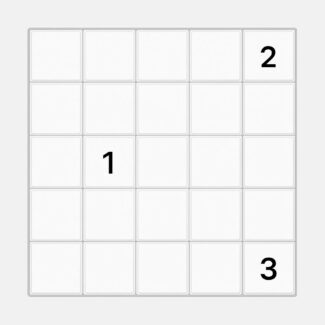
- Memorize where the numbers are.
- After 5 seconds, they will disappear.
- Your task is to tap the cells in the correct order: first 1, then 2, then 3, and so on.
- One mistake ends the game.
- With each level, the number of digits increases.
💭 Train your spatial memory by recalling where the numbers were
This is an engaging cognitive game that tests and develops your ability to remember the positions of objects within a limited space. The idea sounds simple: you see a 5×5 grid where numbers appear for a few seconds. Then they vanish — and your job is to tap the correct cells from memory in the right sequence. Miss one? Back to the start. Get it right? Welcome to the next, tougher level. The rules are deceptively simple: by levels 6–7, it becomes a serious challenge even for people who consider their memory excellent.
🧠 What does this game train?
Spatial memory is a key component of overall intelligence. It underpins your ability to navigate, recognize patterns, remember routes, coordinate movement, and even grasp abstract structures such as mathematics or music. This game trains:
- the ability to remember object locations;
- working with sequences (in that sense, it’s similar to “Repeat the Rhythm”);
- short-term information retention;
- orientation in 2D space;
- attention and focus;
- coordination between the brain’s hemispheres.
This kind of training is useful not only for children, but also for adults — especially if you notice you’re starting to get tangled in plans, struggle in unfamiliar places, or forget where you put things.
❓ How does the game work?
At the start, the player sees a square 5×5 grid. After pressing the “Start” button:
- Numbers are placed randomly on the grid: first 1, 2, 3.
- After 5 seconds, they disappear.
- The player must tap the cells from memory in ascending order: first where 1 was, then 2, then 3.
- If everything is correct, the player advances to the next level, where a new number is added: 4, then 5, and so on.
- If there’s a mistake, the game ends, the correct answers are shown, and the player can start over.
Each new level adds one more step to the sequence, making the task harder: you have to remember not only where each digit was, but also the exact order. The game continues until the first mistake.
🧩 Why is it difficult?
At first glance, it’s just 3 digits and 25 cells. Sounds easy. But once 5–6 numbers appear, it becomes much harder for the brain to hold both the order and the coordinates. Especially if the digits are placed close together — or, наоборот, in different corners. The difficulty ramps up fast.
Also, unlike ordinary memorization, you can’t simply “repeat” the information here. You have to experience it in space. That takes visual imagery, a motor plan (where would I tap), and logic.
⚠️ Examples of mistakes — and what they reveal
- you tapped 2 instead of 1: you mixed up the order.
- you tapped a neighboring cell: you remembered the position “roughly,” but not precisely.
- you forgot entirely where things were: you overestimated your working-memory capacity.
All of these are useful signals that help you understand how your thinking works.
✔️ What are the benefits?
Research suggests that spatial working memory is closely linked to:
- academic performance (especially math and geometry);
- driving skills;
- reading maps and diagrams;
- working with tools and technical drawings;
- programming, engineering, and design.
Training spatial memory is beneficial for both children and adults. For children, it builds foundational skills; for adults, it can help slow cognitive aging and reduce age-related memory decline.
🔝 How can you improve your score?
Here are a few strategies that can help.
- Break the grid into zones: “top-left corner,” “center,” “bottom row” — it’s easier to remember.
- Memorize in chunks rather than individually: for example, “1 and 2 are next to each other,” “3 is in the bottom-right.”
- Don’t rush: 5 seconds is enough if you use it wisely.
- Breathe deeply: lowering stress helps memory.
👨👩👦👦 Who is this game for?
- Children — to develop visual-spatial thinking.
- Students — to prepare for exams, especially in math and technical drawing.
- Adults — to train short-term memory and prevent cognitive slip-ups.
- Older adults — to keep the brain active.
- Anyone who wants to navigate better and remember routes, схемы, screens, interfaces, and more.
💡 Spatial memory and IQ
Although this game isn’t a direct intelligence test, it targets one of the most important components of IQ — working memory. In essence, it trains the same system used in Raven’s matrices tests: visual tasks, puzzles, and challenges that require “holding objects in the mind.”