
Nonverbal IQ Test
Carefully read this short instruction before starting the test.
The test consists of 60 questions. In each question, you need to choose the missing visual fragment from 6 or 8 options. Each question has only one correct answer.
The questions are divided into 5 series: they differ by the solving principle, the number of patterns, and the level of difficulty. In the test, the series alternate, and the difficulty gradually increases.
The time limit is 20 minutes. Your task is to answer as many questions correctly as possible. You can skip questions: each correct answer has the same weight in the final result.
Free IQ score. No registration. Anonymous.
IQ Scale on the Normal Distribution Curve *
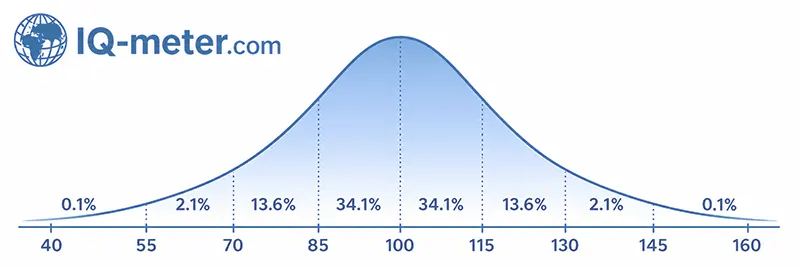
* Based on a normal distribution of IQ scores with a mean of 100 and a standard deviation of 15. The 40–160 range covers approximately 99.9937% of the population.
As a rule, lower scores should be considered less reliable than higher scores.
About the IQ-meter.com test format for assessing intellectual abilities
IQ-meter.com uses a nonverbal task format in which logic, analysis of visual relationships, pattern recognition, and novel problem-solving play the central role. This approach is closely aligned with how psychometrics describes intelligence tests and so-called fluid intelligence, because it does not assess vocabulary or educational background. Instead, it focuses on the ability to notice relationships between elements, draw conclusions, and find a solution in an unfamiliar situation.
A practical advantage of this format is that it relies less on language, terminology, and previously acquired knowledge. Instead of answering general knowledge questions or dealing with long verbal formulations, the test taker works with visual structures in which attention, sequential analysis, rule retention, and cognitive flexibility matter. That is why tasks based on matrix and analogical relationships, which are also used in the IQ-meter.com test, have long served as one of the core tools for assessing cognitive abilities.
Why this format is better suited for users from different countries
For a broad international audience, it is important to provide a test format that reduces the influence of language and culture-specific knowledge. APA materials note that nonverbal tests can reduce cultural influence in the testing process because they do not require extended verbal responses and depend less on language proficiency. That is why this approach is better suited for users from different countries, language backgrounds, and cultural environments than tasks based on vocabulary, school curricula, or local context.
At the same time, it is more accurate to speak not of complete independence from culture, but of reducing its influence on the result. Even so, in online testing, the nonverbal format is better suited than most alternatives for assessing the intellectual abilities of users from different countries and cultural backgrounds. This, in turn, makes it possible to maintain international statistics and compare diverse cohorts more meaningfully.
What the task series assess
First series (A)
The first series assesses the accuracy of basic visual analysis, attention to image structure, and the ability to identify the missing part of a whole. At first, the tasks are based on repeating patterns and backgrounds, and then move on to less symmetrical and more complex visual structures. Here, the user must accurately match part and whole, distinguish pattern from randomness, and maintain steady attention to detail.
Second series (B)
The second series assesses the ability to establish analogies between figures. In each task, the goal is to understand the principle by which one figure changes in relation to another and apply this principle to a new element. These tasks rely on logical comparison, identifying the transformation rule, and keeping one or two patterns in mind at the same time.
Third series (C)
The third series contains 9 figures rather than 4. Here, it is important to determine how the elements change across rows and columns and to track how the figures evolve in several directions. This series requires deeper step-by-step analysis, the ability to keep several rules in mind, and the capacity to build a solution from several interconnected observations.
Fourth series (D)
The fourth series also contains 9 figures, but the elements may be rearranged, so the solution cannot be obtained by simply reading the structure from left to right or top to bottom. The user must first reconstruct the logic of the relationships between the figures and then determine the missing element. Cognitive flexibility, classification of visual features, and application of a rule in a less obvious configuration are especially important here.
Fifth series (E)
The fifth series is designed for more complex tasks, where noticing one local rule is no longer enough. It requires combining several observations, separating essential features from secondary ones, and synthesizing the final solution based on several levels of analysis. This series places a greater load on complex nonverbal reasoning and makes it possible to distinguish results more precisely at higher performance levels.



FAQ (Frequently Asked Questions)
What is an IQ test?
An IQ test is a set of tasks designed to assess logical thinking, the ability to analyze patterns, and the ability to solve new problems. The result reflects how quickly and effectively a person processes new information.
Is the test really free?
Yes. After completing the test, you will receive your IQ score for free. No registration or personal data submission is required. Additionally, you can get a full result breakdown for a small one-time payment.
How accurate is an online IQ test?
Accuracy depends on the quality of the test itself and on the sample used for comparison. IQ-meter.com uses tasks that are well suited for assessing intelligence regardless of education level or cultural background. Measures are also taken to improve sample representativeness, for example by filtering out repeated attempts by the same person. However, the result of any online test should be considered approximate.
How long does the test take?
The time limit for completing the test is 20 minutes.
Does completion speed affect the result?
No. If the same number of tasks is answered correctly, the result will be the same regardless of how much time was used within the time limit.
Can I take the test more than once?
Yes. However, repeated attempts may slightly raise the score because some tasks can be remembered. In addition, repeated attempts are not included in the representative sample.
What does IQ mean? How should it be interpreted?
IQ is a numerical indicator of a person’s intellectual abilities relative to the average, which is set at 100. Most people score between 85 and 115. Results above 115 indicate a high level of intelligence.
What affects IQ level?
Many factors can affect the result, including experience with similar tasks, age, education level, attention, concentration, fatigue, and stress.
Can IQ be improved?
Although innate cognitive predispositions cannot be completely changed, cognitive abilities can be developed substantially. Helpful things include logic tasks, learning new things, memory training, and regular intellectual exercise.
Why can results differ across different tests?
Results may differ because of differences in task types, scoring scales, and result-processing methods.
What age is the test suitable for?
This test provides the most representative results for ages 14 to 65. For children and older adults, the results may be less accurate.